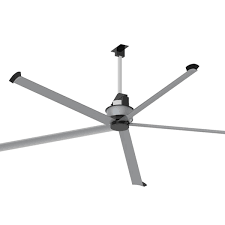
High Volume Low Speed Fan (HVLS)
Large-diameter HVLS fan (16–24 ft) delivering up to 200,000 CFM for industrial and commercial buildings.
About the High Volume Low Speed Fan (HVLS)
An HVLS fan is the right way to ventilate a large open volume — warehouse, factory bay, gymnasium, distribution centre. The 16–24 ft impeller spins slowly (typically 60–80 rpm), producing a wide, gentle column of air that reaches the floor and spreads horizontally for tens of metres, creating a perceived 4–6 °C cooling effect by accelerating evaporation from skin. One HVLS does the work of 30+ ordinary ceiling fans, draws less power, and is silent enough to leave on through a meeting.
Engineering Advantages
One HVLS replaces 30+ ordinary ceiling fans for the same coverage
4–6 °C perceived cooling effect on personnel through evaporative wind-chill
Silent at floor level — under 35 dBA at typical speeds
In winter, reverse-mode destratifies hot air trapped at the ceiling and cuts heating cost
Key Features
- Size range: 16 ft to 24 ft
- Speed control included
Construction & Materials
- Aluminium alloy aerofoil blades, typically 5–10 per fan
- Direct-drive permanent-magnet (PMSM) or gear-reduction motor
- Multiple safety cables per blade beyond the structural mount
- Variable-frequency drive included as standard
- Wall-mount or wireless controller for speed and direction
How to Choose the Right Variant
- 1Pick fan diameter to match the unobstructed footprint: 24 ft for 6 m+ ceilings; 16–20 ft for lower ceilings
- 2Coverage: roughly 25–30 m diameter floor footprint per fan at full speed
- 3Mount at minimum 4.5 m above the floor (24 ft fan); minimum 3.5 m for 16 ft
- 4Avoid placing under sprinklers — local fire codes vary, check before specifying
Installation Notes
- Mount only to a structural member rated for ≥ 5× fan weight (dynamic loading)
- Install all safety cables to independent points on the structure
- Allow ≥ 0.6 m clearance from fan blade tip to any obstruction
- Wire VFD per manufacturer guidance; never bypass with a soft-starter
Maintenance Schedule
- Inspect blade fasteners and safety cables every 6 months
- Wipe blades annually — dust unbalances the fan
- Re-grease gear-drive (if applicable) per manufacturer interval
Industries Served
Standards & Compliance
- Designed in line with AMCA 230 air-circulator performance practice
- Safety cables and structural mount per AMCA 230 / ANSI / ASCE 7 wind loading
- VFD per IEC 61800-3 EMC class
Frequently Asked Questions
Is the perceived cooling effect real?
Yes — moving air across skin accelerates evaporation, dropping perceived temperature by 4–6 °C even when the actual air temperature is unchanged. Standard reference: ASHRAE 55 thermal comfort.
Can it run all year?
Yes — at full speed in summer for cooling effect, and at low speed in reverse in winter to break up the hot-air layer at the ceiling and push it down to occupant level. This destratification typically cuts heating energy by 10–20%.
How loud is it?
Under 35 dBA at floor level for typical industrial duty. Quieter than the ambient noise of a working warehouse.
Need help selecting the right fan?
Our engineers will help you size the high volume low speed fan (hvls) to your exact application — capacity, static pressure, and installation constraints.