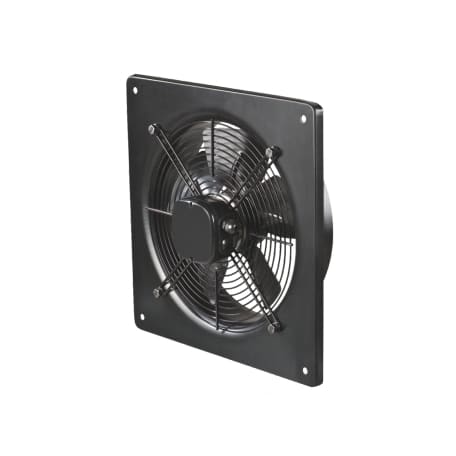
Propeller Fan
High-flow, low-resistance propeller fan for supply and exhaust applications.
About the Propeller Fan
A propeller fan is the most airflow-per-rupee you can get — a simple impeller, a bare orifice, and a guard. It produces almost no static pressure, which means it cannot push through a duct system, but it moves enormous volumes of free air and is unbeatable for spot-cooling, smoke clearance and general workshop ventilation.
Engineering Advantages
Highest CMH per Watt of any fan type
Compact wall-mount form, four sizes from 200 mm up to 600 mm
Optional auto-shutter prevents back-draft when fan is off
Reversible (3-phase) for either supply or exhaust
Technical Specifications
| Size | Air Flow | Voltage | Power | RPM | Sound |
|---|---|---|---|---|---|
| 600 | 10,500 CMH | 220 V | 750 W | 1,380 | 72 dBA |
| 450 | 4,800 CMH | 220 V | 230 W | 1,350 | 64 dBA |
| 300 | 2,100 CMH | 220 V | 125 W | 2,400 | 58 dBA |
| 200 | 900 CMH | 220 V | 50 W | 2,450 | 49 dBA |
Construction & Materials
- Aluminium-alloy impeller with steel hub
- Galvanised orifice plate with welded reinforcement
- Galvanised front and back guards
- Single- or three-phase induction motor
How to Choose the Right Variant
- 1Use only for free-air or near-free-air mounting — < 3 mmwg static
- 2For workshop spot ventilation, pick fan diameter to match opening; do not under-size
- 3Specify the optional auto-shutter for cold-climate sites
Installation Notes
- Mount with the orifice flush to the wall — avoid recessing, which kills airflow
- Provide an equal-area inlet on the opposite wall
- Wire through a service-isolator within sight
Maintenance Schedule
- Wash impeller and orifice annually
- Inspect motor leads quarterly in damp environments
Industries Served
Standards & Compliance
- Guards designed to ISO 13852 / IS 4691 finger-protection
- IP 44 motor protection per IEC 60529
Frequently Asked Questions
Why is the small (200 mm) fan louder per CMH?
Smaller diameter = higher rpm to keep tip speed up, and rpm is the dominant noise driver. If quiet is a priority, prefer a larger, slower fan moving the same air.
Can I duct a propeller fan?
No more than 1–2 m of straight duct, and even then expect 30–40% airflow loss. For ducted work, choose a tube-axial or circular inline.
Related Axial Flow Fans
Need help selecting the right fan?
Our engineers will help you size the propeller fan to your exact application — capacity, static pressure, and installation constraints.